Samuel Alexander OM (6 January 1859 – 13 September 1938) was an Australian-born British philosopher. He was the first Jewish fellow of an Oxbridge college. Read full biography of Samuel Alexander →
The sensory acts are accordingly distinguished by their objects.
Desire then is the invasion of the whole self by the wish, which, as it invades, sets going more and more of the psychical processes; but at the same... →
Hence, in desiring, the more the enjoyment is delayed, the more fancy begins to weave about the object images of future fruition, and to clothe the... →
An object is not first imagined or thought about and then expected or willed, but in being actively expected it is imagined as future and in being... →
It is convenient to distinguish the two kinds of experience which have thus been described, the experienc-ing and the experienc-ed, by technical... →
For psychological purposes the most important differences in conation are those in virtue of which the object is revealed as sensed or perceived or... →
In the perception of a tree we can distinguish the act of experiencing, or perceiving, from the thing experienced, or perceived.
It is more difficult to designate this form of conation on its practical side by a satisfactory name.
The thing of which the act of perception is the perception is experienced as something not mental.
But though cognition is not an element of mental action, nor even in any real sense of the word an aspect of it, the distinction of cognition and... →
Such being the nature of mental life, the business of psychology is primarily to describe in detail the various forms which attention or conation... →
Thus the same object may supply a practical perception to one person and a speculative one to another, or the same person may perceive it partly... →
When we come to images or memories or thoughts, speculation, while always closely related to practice, is more explicit, and it is in fact not... →
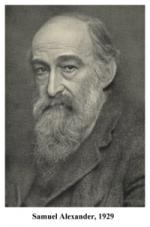 Samuel Alexander OM (6 January 1859 – 13 September 1938) was an Australian-born British philosopher. He was the first Jewish fellow of an Oxbridge college.