Seth Shostak (born July 20, 1943) is an American astronomer, currently Senior Astronomer and Director, Center for SETI research. Read full biography of Seth Shostak →
People don't learn science in movies. You don't go to the movies thinking, 'I hope I learn some quantum mechanics this afternoon.'... →
If the cosmos isn't finite, then far, far away, floating duplicates of your brain - with all its experiences, thoughts, and emotions - are... →
Clearly, enriching the cosmos with heavy elements takes a while. So there's inevitably an interval between the sterile aftermath of the Big Bang... →
It bears mentioning that the Milky Way is only one of 150 billion galaxies visible to our telescopes - and each of these will have its own complement... →
Recent results from astronomers who study the occasional gravitational lensing of unknown worlds by intervening stars suggest that orphan planets... →
The stars look the same from night to night. Nebulae and galaxies are dully immutable, maintaining the same overall appearance for thousands or... →
Sure, nobody will make a fortune if we figure out why the Big Bang happened. But just about everyone would like to know.
The limitless content of our universe might be only one instance of a large (and possibly infinite) number of other universes.
There's no doubt that the Moon is more than a handy night light and a hair restorer for werewolves. It's responsible for the substantial... →
We're not just any star stuff, most of which is humdrum hydrogen and listless helium. Our bodies include fancier ingredients like carbon, oxygen... →
When it comes to brains, size matters. It's not all that matters, of course. Whales and dolphins have brains that are larger than humans'... →
A practical way to travel between the stars is a must-have for space opera, and a sine qua non for our frequently vaunted future as a galactic... →
According to 'Star Trek' mythos, Starfleet Command - operational headquarters for a flotilla of craft that keep the cosmic peace - is located... →
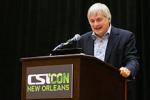 Seth Shostak (born July 20, 1943) is an American astronomer, currently Senior Astronomer and Director, Center for SETI research.